
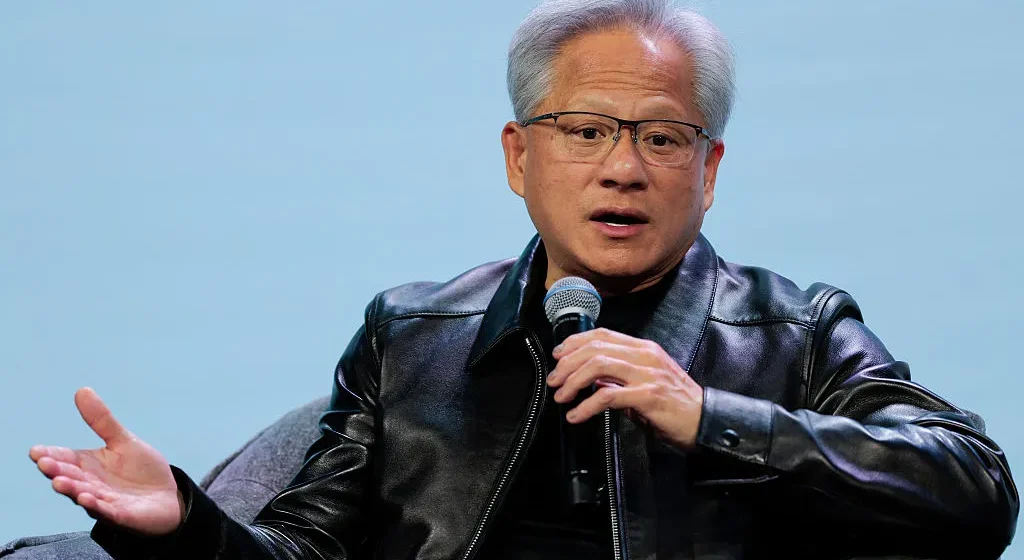
Jensen Huang | American Business Man, Bio, Age, Height, Net Worth, Family, Career, Affair Controversy, Online Profiles & Much More
Jensen Huang is a famous American CEO of NVIDIA, Entrepreneur, investor and Media personality, who was born on Feb 17, 1963 in Tainan City, Taiwan. Find Jensen Huang age, wife, net worth, height, weight, education, career, family, images, biography & more updates.
Jensen Huang is the co-founder, president and CEO of NVIDIA, one of the most valuable companies in the world. He was born on 17 February 1963 in Tainan, Taiwan, which makes him 63 today. He is an electrical engineer by training and an investor and public figure by reputation. Forbes put his net worth at over $200 billion in October 2026, enough to rank him among the ten richest people on the planet. And yet the guy once made $2.65 an hour working at Denny’s.
He started NVIDIA in 1993, at the age of 30, and he has run it ever since. When the company was struggling in the 90s, he was the one who pulled it back from the edge. Over the years he turned it from a graphics card maker into a high-performance computing and AI giant.
Early Life
Huang is the son of Taiwanese parents, and he was born in Tainan, though he spent the first part of his childhood split between Taiwan and Thailand. By his own account it wasn’t an easy start, and he didn’t have the carefree childhood most kids get. Those years shaped the work ethic he is known for today.
The real change came when his family sent him and his brother to the US at the age of nine. They stopped briefly in Oneida, Kentucky, and later ended up in Oregon, where he attended Aloha High School just outside Portland.
The Kentucky part is a story he has told in interviews. An aunt and uncle, who had only recently moved to Washington state themselves, picked a school for the two boys without knowing much about it. They chose Oneida Baptist Institute, thinking it was a regular prep school. It turned out to be closer to a reform school.
Huang has said he cleaned the dorm toilets there. He doesn’t look back on it with bitterness. He says it taught him to give his best at whatever job is in front of him, however small. At 15 he also finished third in junior doubles at the U.S. Open Table Tennis Championship, so he was competitive from an early age.
Education
He earned a bachelor’s degree in electrical engineering from Oregon State University and then a master’s in the same field from Stanford. That education laid the foundation for everything that came later. Stanford is also where he started to think seriously about building a company, and that led him to NVIDIA and the idea of changing what a graphics card could do.
Starting NVIDIA and Almost Losing It
In April 1993, Huang teamed up with Chris Malachowsky and Curtis Priem, two engineers from Sun Microsystems. They talked it through at a Denny’s in San Jose and shared one bet: video games were getting more advanced, and that would create real demand for dedicated graphics chips. Huang became CEO and has held the job ever since.
The start was rough. The first chip sold poorly. A follow-up project for Sega went off track, and the technology no longer matched where the market was heading. Huang had to admit the project should be dropped, even though NVIDIA badly needed the money. Sega executive Shoichiro Irimajiri then stepped in with a $5 million lifeline, which gave the company room to build a better chip. Huang later spoke about it in a 2023 commencement speech: “Confronting our mistake and, with humility, asking for help saved NVIDIA.”
The recovery came with the RIVA 128 in 1997, which sold over a million units in its first four months. That gave the company a real commercial base. The RIVA TNT followed in 1998 and strengthened its place in PC graphics.
Going Public and Looking Beyond Games
NVIDIA listed on the stock market on 22 January 1999. Later that year it released the GeForce 256 and called it the world’s first GPU, since it took graphics work off the computer’s main processor. The GeForce name stuck with gamers from there. In 2000 the company picked up assets from rival 3dfx, and over the next years it moved into professional visualization, scientific computing and console chips. It also made mobile processors, the Shield devices and the GeForce Now cloud gaming service.
Huang’s bigger idea was that a GPU could do much more than draw pictures. A chip built to run thousands of small tasks at once is useful for science, engineering and data work too. NVIDIA introduced CUDA in 2006 and pushed it wider in 2007, so developers could program GPUs for general computing.
It was an expensive bet. Shareholders grumbled for years about the cost and wanted better short-term profits. But CUDA gave researchers a reason to build on NVIDIA hardware, and that loyalty paid off massively once AI took off.
The AI Boom
The turning point came in 2012, when researchers trained AlexNet on NVIDIA GPUs and made a huge jump in image recognition. After that, NVIDIA aimed more and more of its products and software at people building AI. In 2016 it launched the DGX-1, a computer built for deep learning, and Huang personally drove an early unit to OpenAI in San Francisco. The company wasn’t just selling graphics parts anymore. It was supplying whole systems for a brand-new field.
 Melissa O’NeilDakota JohnsonUğur YıldıranPeak Population When It Will Hit The Worlds 40 Countries
It also grew the pieces around its chips. It bought Mellanox for about $7 billion in 2020 to get networking technology for moving data between big machines. A planned $40 billion purchase of Arm from SoftBank fell apart in 2022 because regulators pushed back.
When ChatGPT arrived in late 2022, everyone suddenly wanted to build generative AI, and cloud providers, tech companies and startups started buying computing equipment in huge quantities. NVIDIA was ready, with years of work behind both its chips and its software. The company’s value hit $1 trillion in 2023, then $2 trillion and $3 trillion in 2024, $4 trillion in July 2025 and $5 trillion that October.
The business grew just as fast. Revenue went from $130.5 billion in fiscal 2025 to $215.9 billion in fiscal 2026, with $120.1 billion in net income. In the quarter ended 26 July 2026, NVIDIA reported $96.2 billion in revenue, and $89 billion of that came from data centers. Gaming is still part of the company, but AI infrastructure is now the engine.
Net Worth
Huang earned his fortune as co-founder, president and longtime CEO of NVIDIA. He has led it since 1993 and watched it grow from a video game graphics startup into a business that sells processors, networking gear, software and complete computing systems. He kept a big share of the company when it went public in 1999, and that decision is what eventually made him one of the richest people in the world.
It took decades. NVIDIA nearly failed in its early years, and Huang kept investing in technology that wouldn’t pay off for a long time. When demand for generative AI exploded, the company already had the chips, the software and the developer relationships its customers needed. Estimates of his wealth differ by source and date, and Forbes had him above $200 billion as of October 2026. For a man who once earned $2.65 an hour at Denny’s, that is quite a jump.
Dividends are part of the picture now too. In May 2026 NVIDIA raised its quarterly dividend from one cent to 25 cents a share. On roughly 811.9 million shares, that works out to about $203 million a quarter, or around $812 million a year before tax, assuming nothing changes.
Salary
For fiscal 2026, which ended in January 2026, Huang’s reported pay was $36.3 million. It was $49.9 million in fiscal 2025 and $34.2 million in fiscal 2024. Most of it is stock awards valued at grant date, so it isn’t all cash in hand.
| Component | Amount |
| Base salary | $1.5 million |
| Stock awards (grant-date value) | $24.8 million |
| Cash incentive | $6 million |
| Other compensation | $4.0 million |
| Total | $36.3 million |
Age
Huang is 63. Most people his age are thinking about slowing down, but he is still running NVIDIA day to day and still talks mostly about AI and machine learning. After this many years in tech, he doesn’t seem to be running out of energy.
Family
Huang is married to Lori Huang, and they have two children. One of them, Madison Huang, works at NVIDIA as a senior marketing director. The family stays out of the spotlight as much as it can and keeps its private life private. Their giving is more visible, especially to education and technology causes.
Height
He is about 5 feet 7 inches (170 cm). Not tall, but nobody in tech seems to care. What he has built is a lot bigger than any measurement.
Philanthropy
Jensen huang and Lori have given big gifts to the places that shaped them. They committed $30 million to Stanford for the Jen-Hsun Huang Engineering Center, which opened in 2010. In 2022 they gave $50 million to Oregon State for the Huang Collaborative Innovation Complex, which supports research and education across engineering and science. They also gave $2 million to Oneida Baptist Institute, the Kentucky school from his childhood, for a new girls’ dormitory and classroom building. It was a full-circle moment, since the school was one of the first chapters of his life in America.
They started the Jen-Hsun and Lori Huang Foundation in 2007 with 370,000 NVIDIA shares worth $12.6 million. As the stock climbed and more money went in, the foundation grew into a multibillion-dollar fund. Its 2024 tax return showed $9.2 billion in assets, including $8.6 billion in corporate stock, and $126.3 million paid out in grants that year.
Honors and Awards
Huang has won the Fabless Semiconductor Association’s Dr. Morris Chang Exemplary Leadership Award and the Semiconductor Industry Association’s Robert N. Noyce Award, and Oregon State gave him an honorary doctorate. Time named him one of the 100 most influential people in 2021, and business magazines have praised his leadership of NVIDIA. In April 2026 he received the IEEE Medal of Honor, the organization’s top award, for his work on graphics processors and their use in scientific computing and AI. It comes with a $2 million prize.
Real Estate
Soon after Oregon State, Jensen huang and Lori bought a 1,500-square-foot home in San Jose. They sold it in 1988 for $185,000 and bought another San Jose house that same year for $338,000, which they sold in 2002 for $500,000.
In 2003 they paid $6.9 million for a newly built 7,000-square-foot house in Los Altos Hills. A year later they spent $7.5 million on an 8,000-square-foot home in a gated community on Maui. In 2017 they paid $37 million for a brand-new 11,400-square-foot mansion in San Francisco.

Frequently Asked Questions
Does Jensen Huang have children?
When is Jensen Huang's birthday?
What is Jensen Huang's educational background?
What business ventures and brand deals is Jensen Huang involved in?
What should you know about Jensen Huang's the ai boom?
What is known about Jensen Huang's earnings and wealth?
What do we know about Jensen Huang's personal life and family?
Is Jensen Huang involved in any charity or philanthropy work?
What awards and recognition has Jensen Huang received?
What is Jensen Huang's lifestyle like?
 Svetlana KhodchenkovaWho’s richer?10 rounds · tap a face to play
 Dur-E-Fishan Saleem BioTry a gameWho’s younger?Ten matchups. Tap the celebrity who was born later.Play now →
Compare Jensen Huang with anyone
Pick any celebrity and compare relationships, religion, nationality, education, net worth and more.
Disclaimer
Information source: The information in this article was gathered only through research of publicly available sources on the internet. We try hard to be accurate, but we cannot guarantee that every detail is 100% complete, correct or up to date — mistakes and omissions are possible.
- Dates of birth, ages, family, relationships, career details and awards may be reported differently by different sources or may have changed since this article was written.
- Net worth, income and other money figures are estimates based on public reports, not audited facts.
- This website is not affiliated with, endorsed by or authorised by the person written about. Names, trademarks and images belong to their respective owners.
- The content is for general information and entertainment only. It is not legal, financial, medical or professional advice.
Found a mistake?
Help us keep this profile accurate. Send us the correction and we will check it.



Leave a Reply